Export compliance is never static, in fact, the pace of change is accelerating. For defense, space, and high-technology companies, staying ahead of what’s next with ITAR (International Traffic in Arms Regulations) is no longer optional; it’s essential. Over the coming year, we anticipate several regulatory, enforcement, and policy shifts that will affect the way you build your compliance programs, source components, and enter new markets.
At Maribod Global, as your trade compliance partner, we’re laying out what you should watch for, and prepare for, in the next 12 months around ITAR.
Key trends likely to drive ITAR changes
Here are some developments we believe will shape ITAR’s evolution in the near future:
- Policy & regulatory tightening
With concerns over emerging technologies, AI, quantum, advanced semiconductors, and their potential military applications, ITAR jurisdiction may expand. Expect new rules or proposed rulemaking clarifying what technologies are “defense articles” or “defense services,” especially in dual-use zones (space, robotics, biotech). - More frequent enforcement & audits
The U.S. government has been signaling increased scrutiny of export compliance, especially in sectors like aerospace, satellites, and defense supply chains. Companies should expect more audits, investigations, and civil/penal enforcement actions. Documentation, classification records, and internal compliance culture will be under review. - Increased pressure from foreign policy / national security contexts
Geopolitical tension, especially with focus areas like micro-electronics, space launches, and biotechnology, will continue to push the State Department & Defense Department to use ITAR to control export to certain countries. License denials or delays are likely to be more common for markets deemed risky. - Greater clarity (and complexity) in licensing processes
The application for DSP (Defense Service Provider) licenses, Technical Assistance Agreements (TAA), and manufacturing licenses may see additional detail or tighter requirements. For example, better definitions of “foreign persons,” “deemed exports,” and where responsibility lies in supply chains involving subcontractors or partners. - Interplay with other export / trade regimes
As U.S. export control policy expands and overlaps with sanctions law, EAR (Export Administration Regulations), and tariff regimes, companies will face more cross-regime checks. We may see guidance or rulemaking defining where changes in one regime trigger review in another, and which agency makes final calls. - Technology-driven compliance tools & automation
To keep up, firms will increasingly invest in automated classification tools, better internal tracking of parts/components, and digital platforms for licensing workflows. Auditors will expect more precision and traceable metadata on component origin, source code, technical data transfers, etc.
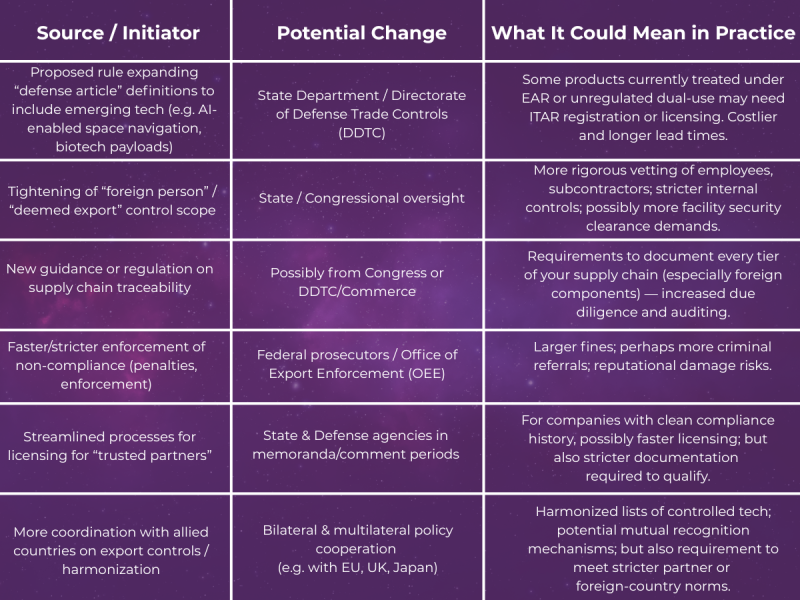
Likely ITAR regulatory changes: What to watch for
Here are specific changes to monitor over the next year:
What Maribod Global recommends your company do now
To stay ahead, don’t wait for the regulations to land. Here are proactive steps to ensure your compliance program is future-proof:
- Gap-assessment of your current ITAR compliance program
Go through your registrations, internal policies, license queue times, subcontractor oversight, and existing classification. Identify weak spots now (e.g. categories of tech you may not yet have considered as defense articles). - Update your classification roadmap
For every component or technology you use (hardware, software, biotech payloads, etc.), classify under both ITAR and EAR; monitor proposed jurisdictions. If there’s a tech you plan to expand into, preemptively research whether the State Department or Commerce intends to change its control status. - Strengthen documentation & audit trails
Ensure that your records are clean, detailed, and defensible. For example: supplier country of origin, chain of supply, technical data transfers, employee or partner clearances, internal compliance training records. - Develop relationships & monitor regulatory filings
Keep an eye on rule proposals, Congressional oversight hearings, and DDTC/Commerce public notices. If possible, engage with trade associations or alliances shaping policy (e.g. Space associations, aerospace/defense bodies). Once draft rule changes are out, comment if possible. - Invest in compliance operations & tools
Think beyond legal review. Consider workflow tools for licensing, automated classification support, software that tracks foreign persons or export-splitting in software source/shared data. Train staff in compliance culture so documentation is more than window dressing, it becomes part of every engineering, business & operations conversation.
Why these changes matter for startups, space & biomanufacturing firms
- For emerging space or biotech in space companies, many parts and processes are borderline between “dual-use” and “defense.” If definitions shift, the cost and time to bring a payload or component into orbit could increase significantly.
- Experienced vendors and partners (suppliers, launch providers, ISS partners) will demand stronger compliance histories; being “squeaky clean” will provide competitive advantage.
- For companies operating internationally, harmonization with foreign export control regimes (UK, EU, Japan) will matter—not just to avoid legal risk, but to succeed in partner procurement and supply chains.
- For women-owned / female-operated tech firms (like Maribod Global), the opportunity is also to lead by example—being early adopters of compliance best practices can help build credibility, open doors, and reduce insurance or contractual pushback when dealing with government contracts or launch providers.
Conclusion
In the next 12 months, we expect ITAR to shift in ways that increase oversight, tighten definitions, demand greater documentation, and accelerate enforcement. These changes won’t be trivial, but for companies that treat compliance as a continuous, forward-looking discipline rather than a reactive cost, they pose major opportunity.
Maribod Global is here to partner with you through every phase: from mapping where your exposure may grow, to building robust internal systems, to positioning your company as a trusted, resilient actor in the space, defense, and advanced tech sectors.
Stay tuned for updates; we’ll monitor rulemakings, proposed guidance, and enforcement cases, and keep you informed so you can lead without being surprised.
Is your ITAR compliance program ready for the changes ahead? Contact Maribod Global today!